Case 05 / Public repository and live application
Will I Gap It?
Translate vehicle inputs into an inspectable comparison using available performance times or power-to-weight and explicit adjustment rules.
My contribution
Gabriel is identified as maintainer. The repository README acknowledges team-account and AI-assisted contributions; personal implementation decisions remain unresolved.
Key result
An inspectable comparison implementation and a genuine anonymous application screenshot demonstrate supporting software work. Prediction accuracy, hosted security and authenticated persistence were not verified.
Results and technical detail ↓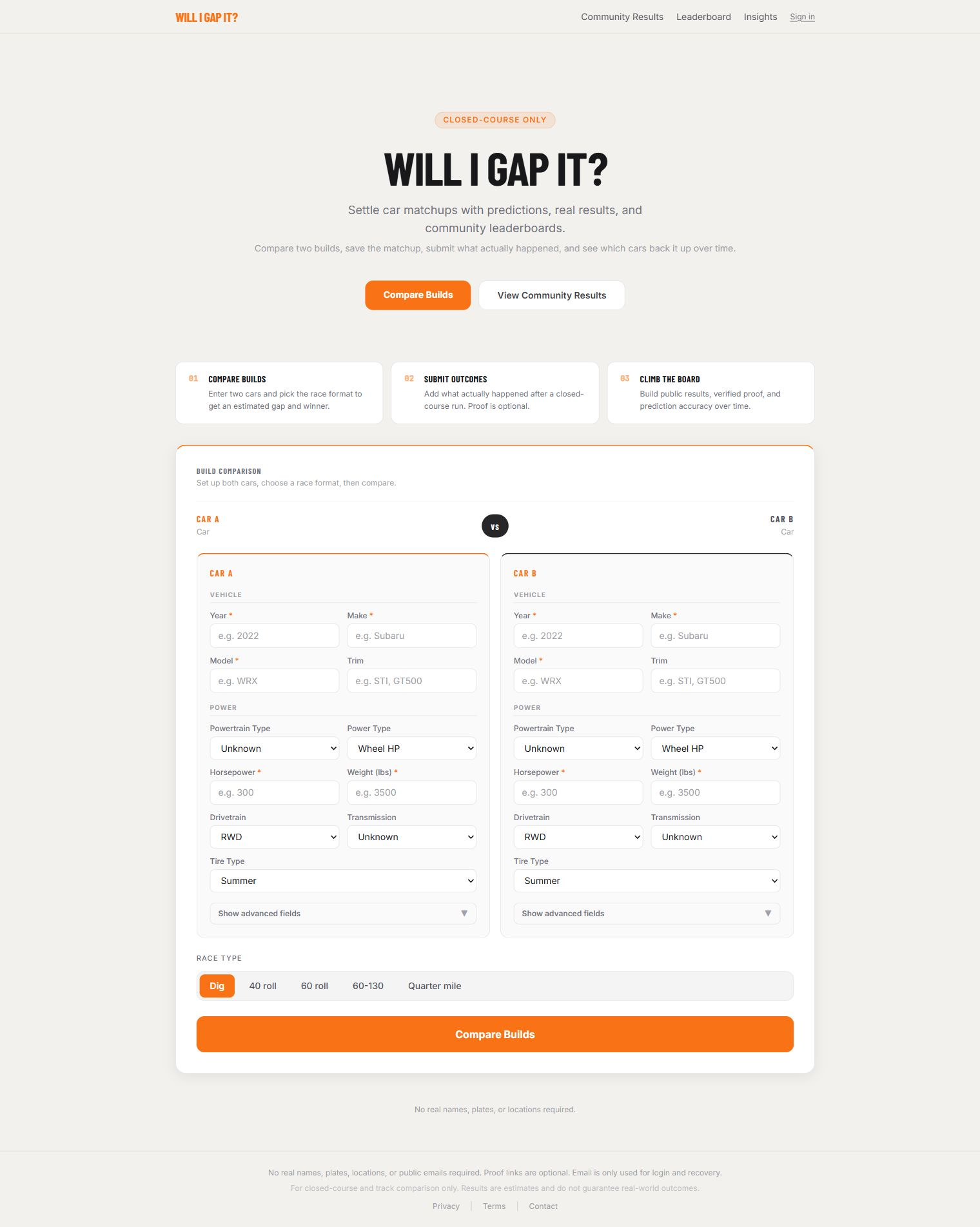 View full size
Constraints
- Closed-course estimates; no validated physics or prediction accuracy claimed.
Implementation and Evidence
The public source uses deterministic heuristics with Next.js, React, TypeScript and Supabase. The screenshot records the anonymous interface observed during the earlier evidence review.
Heuristic confidence labels are categories, not statistical confidence or validated vehicle physics. Version 2 repairs remain local and must not be assumed to be deployed on the linked live site.
Evidence & interpretation
Results & validation
An inspectable comparison implementation and a genuine anonymous application screenshot demonstrate supporting software work. Prediction accuracy, hosted security and authenticated persistence were not verified.
Engineering limitations
Heuristic confidence is not statistical confidence. Hosted security, backend parity, persistence and authenticated flows were not verified.